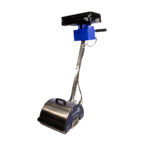
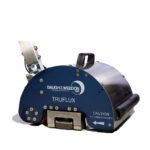
Detailed Overview
The TruFlux is an industrial high resolution digital tank floor plate scanner, using Magnetic Flux Leakage (MFL), for tank floor plate inspection; featuring innovative operator focussed design features. The TruFlux incorporates a unique damping system designed to alleviate the high forces required to break magnetic contact with the inspection surface, giving the operator great control over lift-off and placement. The TruFlux detects corrosion on both top and bottom surfaces, meeting API653. Inspection though coatings is standard, up to 6mm and can inspect thicker plates up to 20 mm (3/4 in) thick.
Developments in the TruFlux software deliver a user-friendly operating system, with an improved data acquistion software (DAQ), enabling quick intuitive set up and a faster plate scan time. It is well documented that for this type of Magnetic Flux Leakage technique, speed variations whilst scanning cause adverse effects on data quality. TruFlux employs a proprietary Speed Compensation Algorithm to help remove resulting spurious indications. With USB connectivity, Scan Data can be easily transmitted back to base, so that inspection data review and report writing can commence while technicians are continuing to work in the Tank.
First line in-field support is available for the TruFlux MFL Scanner with the optional TruFlux spares kits, available with or without a MagnaCheck 3D, meaning key components can easily be
replaced/repaired by operators on on-site; eliminating lengthy downtimes and interruptions to scheduled maintenance plans.
Top Features & Benefits
- Superior Resolution (5.2mm x 1mm)
- Report, Mapping, Alarm on Defect Analysis
- Inspection results overlay feature, helps with predictive analysis
- Rugged Laptop with Windows OS & separate battery supply
- “Easy” lift-off for the operator
- Field repairable with optional spares kit
- Hot swappable batteries
- Armoured cable connectivity
- High resolution optical encoder, positional accuracy of ± 1mm over a 20m scan track
- Fast track-to-track scanning images
- EEMUA 159 and API 653 compliant
Advantages
-
- High resolution increasing POD
- Lightweight, 55kg (inc. battery)
- Easy to transport, total shipping weight under 80kg
- USB connectivity means the Truflux effectively works as a simple “plug and play” unit
- Off-the-shelf battery technology
Industry Solutions
- Petrochemical (Storage Tank Floors, Process Vessels)
- Power Generation
Technical Specifications
A NEW INNOVATIVE CHAPTER IN FLOOR-PLATE INSPECTION
The Truflux incorporates a unique damping system designed to alleviate the usual high forces required to break magnetic contact controlling the scanner lift-off and placement; enabling an easy smooth motion, reducing any high levels of mechanical loading.
The DAQ Software has been developed for both touch-screen and standard pc applications. With fast control function set-up meaning less operator inputs per scan, this results in faster plate scan times.
TruFlux employs a proprietary Speed Compensation Algorithm to help remove spurious indications arising from this speed variations whilst scanning, which can result in adverse effects on data quality. Addtionally scanning speeds are cross-correlated back to the calibration and kept within controlled margins.
Attention has been paid to data acquisition, data handling and communication protocols which is why the entire electronics package is housed within the fully ruggedized scan-head enclosure, powered only by the USB; greatly improving site reliability, protecting the complex electronics from harsh environments.
Increased Digital Resolution with readings from 48 hall affect sensors are captured and digitised every 1.0 mm of forward travel at a scanning speed of 500mm p/sec.
On-board Auto-Drawing, Scaling and File Managment means full-scale drawings of the inspected tank floor, including auto numbering of plates and tracks can be created. Scanned plots can be positioned on to the plates, as can the the plates on to the tank image.
Material loss can be viewed as a high resolution corrossion map with extra features of zooming, panning and saving images.
Automatic scanning strategies can be generated, meaning the operator needs to only follow on-screen guidance.
The DAQ software has a preliminary PDF report output function, enabling the on-site operator to produce a first draft report following inspection completion. This enables the client to be reactive to possible issues.
The Overlay Feature places past inspection results over current ones, in both tank, plate and track format; providing the technician with an indication of corrosion growth/trends, helping with predictive analysis.
| Principle |
Specification |
| Principle of Operation |
Magnetic Flux Leakage |
| Detection |
48 Hall Effect sensors |
| Scan Width |
300mm |
| Method of Propulsion |
DC motor |
| Speed |
500mm/s |
| Thickness Range |
6-20mm |
| Test Through Coatings |
Yes |
| Maximum Coating Thickness |
6mm |
| Maximum Sensitivity |
20% |
| Auto-Stop |
No |
| Power Requirements |
2x Lithium-Ion |
| Transit Case |
Meets IATA requirements for transporting magnetisable material |
| Operating Weight |
55kg |
| Real Time Analysis |
Yes |
| Real Time Averaging |
Yes |
| Real Time Digital Signal Processing |
Yes |
| Freeze Screen Alarm |
No |
| Linear Resolution |
0.5mm |
| Speed Compensation Algorithm |
Yes |
| Sensors |
48 Channels x 0.5mm |
| Scan Length |
Unlimited |
| Scan Plate End Zones |
Yes |
| Adjustable Sensitivity Range |
Yes |
| Fully dampened magnetic contact |
Yes |
| Assisted Magnet Lift-Off |
Yes. Minimal effort required to break magnet contact, resulting in considerably less operator fatigue |
| Scan Length Alignment (whilst in magnetic contact) |
Yes. The scan track can be fully aligned when the magnet is in contact with the plate, alleviating the need to break contact if track alignment was not achieved |
What’s In The Box?
Standard Kit:
- TruFlux MFL Tank Floor Scanner
- 4 TruFlux batteries & charger
- Transit Case
- Rugged Laptop, 4 batteries and charger
Additional Options
- Optional System Calibration Plates (6mm, 8mm, 10mm, 12mm)
- Laser Guide
- TruFlux Spares Kit (F-FKFSTRUFSP1) – without a MagnaCheck 3D
- TruFlux Spares Kit (F-FKFSTRUFSP2) – with a MagnaCheck 3D
Also Known As
MFL Scanner, Tank Floor Inspection, Corrosion Mapping, AST Scanner, Floor Scan
FAQ: Truflux – Magnetic Flux Leakage Tester
What is the Magnetic Flux Leakage (MFL) principle?
MFL is an NDT method where a magnet is used to saturate a ferromagnetic material. Metal loss (corrosion/pitting) causes the magnetic field to “leak” out, which is detected by a sensor array.
What is the main application of the Truflux system?
It is primarily used for fast, large-area floor and wall scanning in storage tanks to detect and map corrosion pitting.