GammaTec Navigation
Your One Stop NDT Equipment Supplier
Office Hours: 7am-5pm Mon-Thu 7am-4pm Fri
  • NDT Solutions
    Method / Genre
    Brands
    Industry
    Spotlight
    Conventional Ultrasonic
    Advanced Ultrasonic
    Acoustic Emission
    Guided Wave
    Conventional Radiography
    Digital Radiography
    Electromagnetic
    Material Analysers
    Hardness Testing
    Leak Detection
    Post-Weld Heat Treatment
    Drones & Robotics
    Visual Inspection
    Wire Rope Testing

    Conventional Ultrasonic

    This method utilizes standard high-frequency sound waves to measure thickness and accurately locate internal material flaws. Explore our comprehensive range of standard gauges, intrinsically safe devices, specialized underwater equipment, and highly reliable flaw detectors.

    Advanced Ultrasonic

    Cutting-edge multi-element phased array technology designed for complex geometries and advanced visualization. Find high-quality phased array systems, highly sensitive multi-element probes, transducers, and optimized angle wedges for precise testing.

    Acoustic Emission

    Designed to detect and monitor transient elastic waves caused by rapid energy release within materials under stress. Browse our selection of real-time valve monitoring systems to easily identify leak-through and critical structural stress.

    Guided Wave

    Perform rapid, long-range screening of pipelines and structures to confidently detect corrosion and defects over vast distances. Discover specialized long-range ultrasonic testing collars, advanced transducer rings, and highly accurate screening software.

    Conventional Radiography

    A time-tested film-based radiography method utilizing X-ray and gamma-ray sources for perfectly clear internal structural imaging. Equip your team with robust gamma projectors, close proximity systems, darkroom processing chemicals, and comprehensive radiation safety gear.

    Digital Radiography

    Modern digital sensors and computed radiography equipment delivering instant, high-resolution internal inspection imagery. Find flexible CR imaging plates, high-speed scanners, digital X-ray flat panel detectors, and portable X-ray generators.

    Electromagnetic

    Fast and highly sensitive electromagnetic fields used primarily for surface crack detection and metal sorting. Discover advanced eddy current testers, pulsed eddy current systems, magnetic flux leakage scanners, yokes, and Ardrox consumables.

    Material Analysers

    Identify elemental composition and verify material grades quickly using specialized portable spectroscopy equipment. Browse our industry-leading handheld XRF and LIBS spectrometers for instant, non-destructive chemical analysis.

    Hardness Testing

    Ensure component strength and structural integrity by safely measuring the physical hardness of metals. Explore our range of portable hardness testers utilizing Leeb, Rockwell, and Ultrasonic Contact Impedance (UCI) methods.

    Leak Detection

    Discover microscopic escapes of gases or liquids to guarantee pressure containment and environmental safety. Find high-precision acoustic leak detectors and tracer gas equipment to pinpoint containment breaches instantly.

    Post-Weld Heat Treatment

    Relieve residual material stress after welding processes using controlled and precisely monitored thermal equipment. Equip your site with durable ceramic heating pads, precise power sources, automated chart recorders, and thermocouple accessories.

    Drones & Robotics

    Remote-controlled inspection vehicles and crawlers for safe assessment of hazardous, confined, or hard-to-reach areas. Discover collision-tolerant unmanned aerial vehicles (UAVs), magnetic pipe crawlers, and advanced visual inspection software.

    Visual Inspection

    High-precision optical tools, surface scanners, and borescopes to examine visible exterior defects or finishes. Explore cutting-edge 3D handheld surface scanners, geometry analysis software, and precision surface roughness tools.

    Wire Rope Testing

    Specialized magnetic testing to identify broken wires or structural wear and tear in heavy load-bearing cables. Find dedicated magnetic wire rope inspection heads and continuous monitoring systems to secure cranes and rigging lines.
    Mining
    Oil & Gas
    Petrochemical
    Automotive
    Railway
    Aerospace
    Engineering

    Mining

    Specialized NDT solutions and equipment tailored for the extreme demands of the mining sector. Find robust radiation safety gear, essential thickness gauges, advanced drone surveying tools, and phased array systems for structural engineering.

    Oil & Gas

    We are currently curating specialized equipment lists for this industry. Our robust offerings for Oil & Gas are coming soon!

    Check Back Soon

    Specialized structure currently under construction.

    Petrochemical

    We are currently curating specialized equipment lists for this industry. Our advanced offerings for Petrochemical testing are coming soon!

    Check Back Soon

    Specialized structure currently under construction.

    Automotive

    We are currently curating specialized equipment lists for this industry. Precision tools for Automotive engineering are coming soon!

    Check Back Soon

    Specialized structure currently under construction.

    Railway

    We are currently curating specialized equipment lists for this industry. Heavy-duty Railway NDT solutions are coming soon!

    Check Back Soon

    Specialized structure currently under construction.

    Aerospace

    We are currently curating specialized equipment lists for this industry. High-accuracy NDT instruments for Aerospace are coming soon!

    Check Back Soon

    Specialized structure currently under construction.

    Engineering

    We are currently curating specialized equipment lists for this industry. Dedicated Structural Engineering NDT solutions are coming soon!

    Check Back Soon

    Specialized structure currently under construction.

    EXERTUS FORTES

    EXERTUS FORTES

    The Exertus Fortes is ISO3999:2004 compliant and built with robust safety features. It accepts both Ir-192 and Se-75 sources, with a maximum capacity of 120 Ci (4.44 TBq) for both isotopes. It is lighter than many competing models, weighing just 23 kg with its polyurethane jacket. A key design element is the source channel, which uses a helicoidal design and Tungsten shielding to ensure smoother movement of the source assembly, enhancing both user-friendliness and safety. It operates across a wide temperature range of -45°C up to +70°C.
    The Exertus Fortes offers a superior combination of high-capacity source handling, exceptional portability and advanced safety mechanisms, making it an efficient and user-friendly choice for high-volume field radiography projects.
    Top Features & Benefits
    • Accepts Ir-192 or Se-75 sources (up to 120 Ci).
    • Tungsten source channel and helicoidal labyrinth for smooth operation and durability.
    • Lightweight: Just 24 kg with Jacket.
    • Compact Design.
    • Automatic Source Assembly Locking Mechanism.
    • 2 Colour Signal Safety Indicator for safety status communication.
    • Projector can be disconnected and locked only with source in safe position.
    View Product Details
  • Specials
  • Isotopes

    Isotopes

    The backbone of Non-Destructive Testing (NDT) for critical infrastructure. Providing highly reliable Se75 & Ir192 sources.
  • About Us

    About Us

    GammaTec NDT Supplies SOC Ltd, founded in 1981, is a leading provider of non-destructive testing (NDT) equipment, accessories, and consumables. With over 44 years of experience, the company has established a reputation for delivering high-quality solutions and outstanding customer support.
  • News & Events

    News & Updates

    View our latest news, product announcements, industry insights, and access our exclusive Key Equipment Magazine.
  • Resources & Training

    Resources Hub

    Explore our comprehensive library of product data sheets, safety documents, training materials, and access support portals for your NDT equipment.
GammaTec Mobile Navigation
GammaTec Product Sidebar

Ultrasonic Inspection of Flange Faces in Pipelines

What is Pipeline Corrosion and Erosion?

Pipelines are critical infrastructure assets. However, corrosion poses significant risks to their integrity. Ultrasonic testing (UT), particularly phased array ultrasonic testing (PAUT), is pivotal for corrosion mapping.

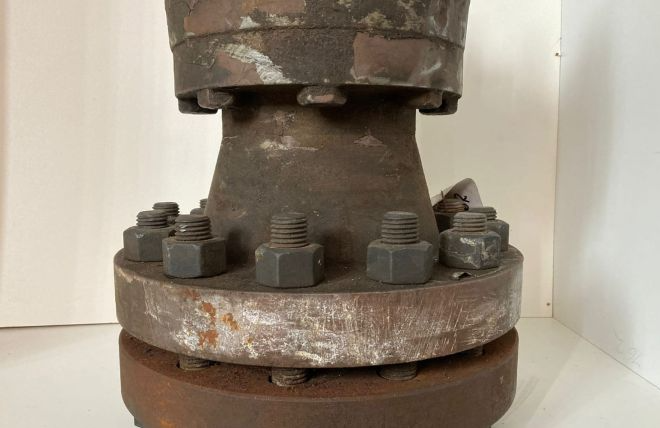
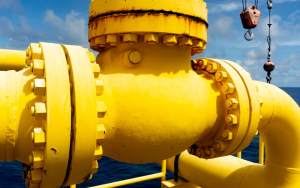
Flanges play a crucial role in maintaining the integrity and safety of pipeline systems, providing secure connections between pipes, valves, tees, and other fittings. Valves are often chosen over welded joints for the ease of maintenance; a spool or valve can easily be replaced by simply disconnecting the flange and swapping out the defective part with a new one. This saves downtime on the overall system where cutting and welding a replacement can take days in some cases.
download 8
Fig. 1 – Flange connections on offshore pipeline

Inspection Methods

The inspection of flanges is critical to the safety and integrity of the pipeline or vessel they are attached to. Traditionally, the simplest way to identify an issue with a flange face is to observe a leak or “split” the joint to visually inspect the face when the line is off for maintenance.

There are obvious issues with these methods: observing a leak means the flange has already failed and containment is lost—this is too late. Conducting visuals require the system to be offline and the flange to be opened, which involves removing bolts and lowering one or both sides of the connection. This is time-consuming and expensive, as some pipelines may include hundreds of connections.

Ultrasonic methods can be used to inspect flange face condition without the need to open the flange or even empty the line! This enables the user to inspect the flange face without forcing the shutdown of the asset. Ultrasonic inspection is often the preferred choice to ascertain flange face condition.


Inspection Challenges

Ultrasonic inspection of flanges, while effective, comes with several challenges:

  • Geometry: Flanges come in various shapes and thickness combinations, providing challenges for probe contact. Wedge contouring and scanners may be needed to ensure consistent contact.
  • Bolt restrictions: Both the bolts and bolt holes cause test restrictions, blocking 100% coverage and restricting probe position.
  • Inspection surface access: Lagging and proximity to adjacent pipework can restrict access to certain scanning surfaces.

Inspection Surfaces

Flange face inspection can be carried out from three main surfaces, each with their own pros and cons.

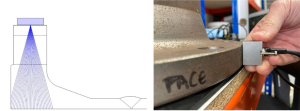
Outer Face

The outer face is often the easiest surface to access, giving 360° contact with a good view of the inner bore of the flange. However, the curved surface can lead to an unstable probe position and the bolt holes prevent 100% scan coverage.
download 9
Fig. 2 – Outer face scan position

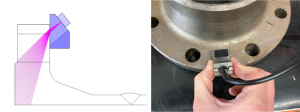
Bolted Face

The bolted face is a good flat surface where the probe can sit easily. However, the bolts prevent 100% scan coverage; in some high-pressure lines, the number of bolts can prevent probe access altogether.
download 11
Fig. 3 – Bolted face scan position

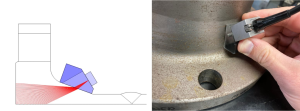
Pipe / Tapered section

This provides a 360° surface with good scanning conditions, but it is the most difficult to access and requires the bolts to give enough clearance for a probe.
download 13
Fig. 4 – Pipe / Tapered section scan position

Ultrasonic Solutions

Conventional Ultrasonic Inspection (UT)

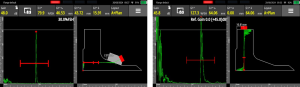
Conventional UT is an invaluable tool for quickly identifying flange face defects. Historically, this has relied heavily on operator expertise to detect signals amidst complex geometries.

The Sonatest Wave enhances this process by providing inspectors with an interactive scan plan and the ability to import CAD DXF files. This helps users distinguish between geometric and defect signals more effectively.
download 14
Fig. 5 – Conventional UT using the Wave

Phased Array Inspection (PA)

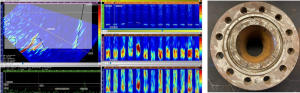
Phased Array (PA) has revolutionized flange face inspection by enabling the capture of detailed scan images. This allows for a comprehensive view of the flange face without disassembly. By recording defects, asset owners can monitor issues over time, facilitating planned maintenance.
download 16
Fig. 6 – Phased Array scan data from a flange face

Total Focusing Method (TFM)

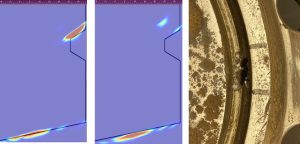
TFM offers the ability to target critical areas and provide data focused on the Region of Interest (ROI). The higher resolution allows for more accurate defect sizing.

TFM can be used alongside PA on the Veo3, enhancing the overall process and resulting in more detailed reports.
e4de31be 1ded 4ae7 8f2b d752441b46d0 1
Fig. 7 – TFM images showing no defect (left) corrosion defect (middle) and defect image (right)

Conclusion

The inspection of flanges is a critical aspect of maintaining pipeline safety. While traditional visual methods have limitations, advanced ultrasonic techniques offer significant advantages. Methods including Conventional UT, PA, and TFM provide accurate assessments without system shutdowns, ultimately enhancing the overall efficiency and safety of operations.

Written by: Sam Hughes, Sonatest