


What is Pipeline Corrosion and Erosion?
Pipelines are critical infrastructure assets. However, corrosion poses significant risks to their integrity. Ultrasonic testing (UT), particularly phased array ultrasonic testing (PAUT), is pivotal for corrosion mapping.
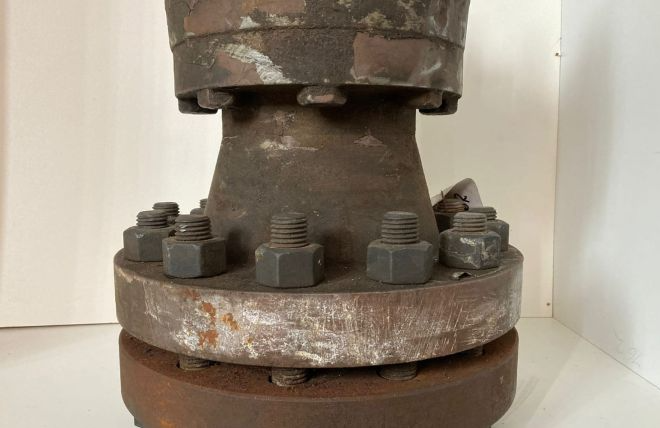
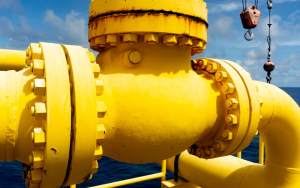
Flanges play a crucial role in maintaining the integrity and safety of pipeline systems, providing secure connections between pipes, valves, tees, and other fittings. Valves are often chosen over welded joints for the ease of maintenance; a spool or valve can easily be replaced by simply disconnecting the flange and swapping out the defective part with a new one. This saves downtime on the overall system where cutting and welding a replacement can take days in some cases.

Inspection Methods
The inspection of flanges is critical to the safety and integrity of the pipeline or vessel they are attached to. Traditionally, the simplest way to identify an issue with a flange face is to observe a leak or “split” the joint to visually inspect the face when the line is off for maintenance.
There are obvious issues with these methods: observing a leak means the flange has already failed and containment is lost—this is too late. Conducting visuals require the system to be offline and the flange to be opened, which involves removing bolts and lowering one or both sides of the connection. This is time-consuming and expensive, as some pipelines may include hundreds of connections.
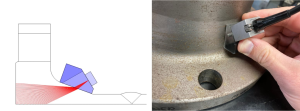
Ultrasonic methods can be used to inspect flange face condition without the need to open the flange or even empty the line! This enables the user to inspect the flange face without forcing the shutdown of the asset. Ultrasonic inspection is often the preferred choice to ascertain flange face condition.
Inspection Challenges
Ultrasonic inspection of flanges, while effective, comes with several challenges:
- Geometry: Flanges come in various shapes and thickness combinations, providing challenges for probe contact. Wedge contouring and scanners may be needed to ensure consistent contact.
- Bolt restrictions: Both the bolts and bolt holes cause test restrictions, blocking 100% coverage and restricting probe position.
- Inspection surface access: Lagging and proximity to adjacent pipework can restrict access to certain scanning surfaces.
Inspection Surfaces
Flange face inspection can be carried out from three main surfaces, each with their own pros and cons.
Outer Face
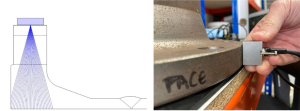
The outer face is often the easiest surface to access, giving 360° contact with a good view of the inner bore of the flange. However, the curved surface can lead to an unstable probe position and the bolt holes prevent 100% scan coverage.

Bolted Face
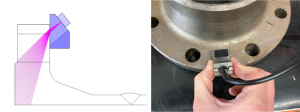
The bolted face is a good flat surface where the probe can sit easily. However, the bolts prevent 100% scan coverage; in some high-pressure lines, the number of bolts can prevent probe access altogether.

Pipe / Tapered section
This provides a 360° surface with good scanning conditions, but it is the most difficult to access and requires the bolts to give enough clearance for a probe.

Ultrasonic Solutions
Conventional Ultrasonic Inspection (UT)
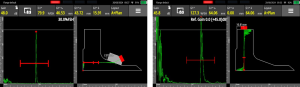
Conventional UT is an invaluable tool for quickly identifying flange face defects. Historically, this has relied heavily on operator expertise to detect signals amidst complex geometries.
The Sonatest Wave enhances this process by providing inspectors with an interactive scan plan and the ability to import CAD DXF files. This helps users distinguish between geometric and defect signals more effectively.

Phased Array Inspection (PA)
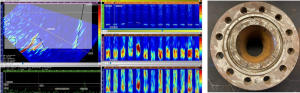
Phased Array (PA) has revolutionized flange face inspection by enabling the capture of detailed scan images. This allows for a comprehensive view of the flange face without disassembly. By recording defects, asset owners can monitor issues over time, facilitating planned maintenance.

Total Focusing Method (TFM)
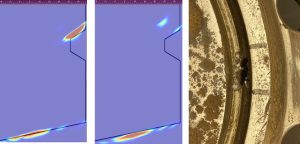
TFM offers the ability to target critical areas and provide data focused on the Region of Interest (ROI). The higher resolution allows for more accurate defect sizing.
TFM can be used alongside PA on the Veo3, enhancing the overall process and resulting in more detailed reports.

Conclusion
The inspection of flanges is a critical aspect of maintaining pipeline safety. While traditional visual methods have limitations, advanced ultrasonic techniques offer significant advantages. Methods including Conventional UT, PA, and TFM provide accurate assessments without system shutdowns, ultimately enhancing the overall efficiency and safety of operations.
Written by: Sam Hughes, Sonatest